Wednesday, April 30, 2008

Dutch Hospital Installs Sun MD Container - Data Center Knowledge

Dutch Hospital Installs Sun MD Container - Data Center Knowledge: "Data center containers are gaining traction, and Sun Microsystems (JAVA) is the latest company to reveal a new customer. A Sun MD S20 (Blackbox) unit has been bought and installed by the Radboud University Medical Center in Nijmegen, the Netherlands. Joerg Schwarz of Sun has photos showing the process of installing a Sun Modular Data Center, including detailed views of the preparation of the pad. As with several previous installations, the 'Blackbox' is actually white (I guess the black version with the green logo looked better in marketing brochures)."

Sun was the first company to make headlines when it introduced the "data center in a box" concept in October 2006. Container-based data centers have since been introduced by Rackable Systems (RACK), Verari Systems and most recently by IBM (IBM) with its iDataPlex series.

Here's a recap of the other Sun MD customer deployments that have been made public:

  • The Stanford Linear Accelerator Center (SLAC) became the first site to deploy a Sun MD last July, using the unit to boost its scientific computing capacity by a third. The SLAC has since purchased a second unit.
  • Mobile Telesystems, the largest mobile phone operator in Russia, has deployed several Blackboxes to manage remote operations.
  • Belgium-based Hansen Transmissions is employing Sun MD S20s in its program to expand wind turbine and industrial gearbox manufacturing facilities in India and China.
  • 30 Blackbox units will be lowered into a former coal mine located 100 meters under the ground in Japan's Chubu region. Sun is part of an 11-company joint venture building the data center, with other partners including Internet Initiative Japan (IIJ and BearingPoint (BE).

Gartner: iDataPlex is the Future of Servers - Data Center Knowledge

Gartner: iDataPlex is the Future of Servers - Data Center Knowledge: "Gartner released a research note Tuesday on the shift in the server market towards Web 2.0 and high performance computing, exemplified in IBM's launch of the iDataPlex server last week. Gartner analysts John Enck, Andrew Butler and Carl Claunch believe that 'innovation in packaging will continue to drive data center density.' An excerpt:

Sales of servers in the Web 2.0 and high-performance computing (HPC) niches are outpacing those in the general server market. These two segments currently have unique requirements: Purchasers want the lowest-cost, lowest-overhead server, but with the most efficient power management and cooling. IBM's iDataPlex is explicitly targeted at these market segments and provides IBM with an architectural framework for addressing the emerging interest in cloud computing. ... Although iDataPlex is not appropriate for most enterprises today, it points to where server hardware is heading. Servers have evolved from tower servers to blade servers mounted in a chassis — and now the rack itself is becoming an integral part of the server.

Gartner said it expects similar offerings from a number of mainstream vendors within the next two years."

A Web-Scale Computing Architecture

IT Conversations | O'Reilly Emerging Technology Conference | Werner Vogels: "One of the key difficulties in running and managing an internet business lies in building a technical infrastructure that can handle spikes in traffic but which remains cost-effective for normal operations. In other words, businesses often need to be able to scale up or down at a moment's notice.

These problems affect companies of all sizes and are as relevant to an enterprise trying to shave costs as they are to a start-up.Werner Vogels presents the Amazon solution and shows how their S3 (Simple Storage Service) and EC2 (Elastic Computing Cloud) offerings provide a blueprint for 'Web-Scale Computing'. Vogels contends that this allows businesses to outsource their 'heavy lifting' and implement an elastic business model that can quickly respond to demand.

Vogels introduces customers who are already using these business models. One of these is our very own Doug Kaye, who describes how Gigavox Media is exploiting the potential of Amazon's web services."

Thoughtstream: Firefox, Google, Cloud Apps, and Mesh | sarahintampa

Thoughtstream: Firefox, Google, Cloud Apps, and Mesh | sarahintampa

Tuesday, April 29, 2008

Aptana to Launch Cloud Platform

Aptana to Launch Cloud Platform: "When released, Aptana Cloud will be the first elastic application cloud with ready-made Web stacks for the most popular scripting languages, 'featuring the most popular and widely adopted Web infrastructure, ready to use and scale as you need it,' Hakman said. 'You can develop on your desktop and sync out to the cloud.'

Aptana Cloud features ready-to-go services, such as PHP, MySQL and Apache Web servers. In addition, Aptana Jaxer enables AJAX developers to use their JavaScript and AJAX skills on the server-side to build entire applications, data services or presentation tiers that complement PHP and Ruby On Rails.

“Ruby on Rails is what's next on deck for Aptana Cloud support, and Python would be a natural extension, too.' Hakman told eWEEK.

Meanwhile, Aptana Cloud is built to complement cloud infrastructure providers such as Amazon, Google and Joyent, Hakman said. Aptana's initial cloud computing partner in the effort is Joyent."

Monday, April 28, 2008

Microsoft’s elephant in the OS room: Apple | Between the Lines | ZDNet.com

Microsoft’s elephant in the OS room: Apple | Between the Lines | ZDNet.com: "In our Pacific Crest Mosaic surveys, we have seen increasing evidence of Apple taking share in the enterprise market. While Apple is not the only reason for the Microsoft Client shortfall, it seems plausible that it could be a larger factor than acknowledged by Microsoft. As a result, we are somewhat skeptical of Microsoft’s assumption that its Client revenue will snap back next quarter."

Typical Programmer - Relational Database Experts Jump The MapReduce Shark

Typical Programmer - Relational Database Experts Jump The MapReduce Shark: "In this article relational database experts David DeWitt and Michael Stonebraker compare MapReduce to traditional relational database systems (RDBMSs) and find MapReduce wanting. They make some strong points in favor or relational databases, but the comparison is not appropriate. When I finished reading the article I was thinking that the authors did not understand MapReduce or the idea of data in the cloud, or why programmers might be excited about non-RDBMS ways to manage data."

"MapReduce has the same relationship to RDBMSs as my motorcycle has to a snowplow — it’s a step backwards in snowplow technology if you look at it that way."

from the comments to this post:

"Other articles I’m inspired to write based on the referenced article: I tried using MapReduce to create a website, and it sucks compared to markup with CSS. It doesn’t have any concept of how to style a website. MapReduce is a serious step backward in terms of web design.

I also tried to have MapReduce babysit my kids, and I came back half an hour later to find that it was just sitting there crunching data, and wasn’t watching them at all. This thing can’t do anything at all.

Also, compared to a standard hammer, this MapReduce things is really crappy at pounding nails into things."

MapReduce: A major step backwards - The Database Column

MapReduce: A major step backwards - The Database Column: "As both educators and researchers, we are amazed at the hype that the MapReduce proponents have spread about how it represents a paradigm shift in the development of scalable, data-intensive applications. MapReduce may be a good idea for writing certain types of general-purpose computations, but to the database community, it is:

1. A giant step backward in the programming paradigm for large-scale data intensive applications

2. A sub-optimal implementation, in that it uses brute force instead of indexing

3. Not novel at all -- it represents a specific implementation of well known techniques developed nearly 25 years ago

4. Missing most of the features that are routinely included in current DBMS

5. Incompatible with all of the tools DBMS users have come to depend on

First, we will briefly discuss what MapReduce is; then we will go into more detail about our five reactions listed above."

As noted below, David DeWitt has recently been given a major gig heading up a new database research lab for Microsoft at the University of Wisconsin, Madison. -- MG

Create PDFs via Code with Adobe Share API

Create PDFs via Code with Adobe Share API

Adobe has updated Share, their service for document sharing and management, so that users can now convert uploaded documents into PDF and they also have exposed this functionality in the Share API. This is a useful enhancement that should broaden the utility of the service (we previously looked at the Adobe Share API in our coverage of 10 Online Storage APIs).

OAuth Coming to All Google Data APIs

OAuth Coming to All Google Data APIs
Like the feature on many cars today where you give the parking attendant a special key to your car that gives him some, but not all, access to your vehicle. On the Web you now have your own keys to dozens of sites but how to best handle the mashup-style case of site A wants you to grant them access to get some data from site B? Ideally you don’t want to give site A your password to site B. OAuth aims to simplify this problem: “It allows you the User to grant access to your private resources on one site (which is called the Service Provider), to another site (called Consumer, not to be confused with you, the User).”

Backlash starts against 'sexy' databases | Reg Developer

Backlash starts against 'sexy' databases | Reg Developer: "Holland, who said he understands the shortcomings of a relational database but also knows its strengths, concluded: 'The bottom line is don't tell me RDMBS can't scale if you can't write a decent query or design a normalized database schema.'

Elsewhere, evangelists have been taken to task for hype, by 'fawning' and posting comments 'verging on satire' in their support of the new wave - specifically, SimpleDB. Todd Hoff praised SimpleDB for eliminating much of the complexity of traditional RDBMS systems by dispensing with tiresome technicalities such as data schema and normalization. He said such things are unnecessary for many web applications.

Defending RDBMS, computer science student Ryan Park listed 10 reasons for avoiding SimpleDB, CouchDB and Google DataStore. Among them: data integrity is not guaranteed, complicated reports and ad hoc queries will require a lot more coding, and relational databases are scalable even with massive data sets.

'Mr. Hoff's supposed advantages are actually serious disadvantages to the paradigm. Before designing your architecture around a database engine like SimpleDB, it's important to consider the reasons not to do so,' Park wrote."

Ubuntu man says Microsoft's about to 'swallow a hand-grenade' | Reg Developer

Ubuntu man says Microsoft's about to 'swallow a hand-grenade' | Reg Developer: "During a recent interview in London, Shuttleworth had plenty to say about Microhoo.

"The Microsoft and Yahoo thing is fascinating," he told me. "I think the ad game is lost. So, Microsoft buying Yahoo! now on search? Come on. Two failing operators will just continue to decline together. On search, I think it's totally a waste of time."

...

"I think this game will swing from the desktop to the web and eventually back again in really interesting ways. They already have a hell of a big investment in whatever their vision is. It's not like they were waiting to buy Yahoo!. They were spending gagillions of dollars, which they have, on data centers for that sort of vision. So, what does Yahoo give them then? A brand, which they will probably screw up."

Microsoft snags Google-thrashing data pioneer | Reg Developer

Microsoft snags Google-thrashing data pioneer | Reg Developer: "Recently DeWitt and Postgres architect Mike Stonebraker co-authored a controversial attack on Google's MapReduce database. Their view that MapReduce was "a giant step backwards" provoked a robust response from Google's supporters."

Hadoop 0.17 Preview (Hadoop and Distributed Computing at Yahoo!)

Hadoop 0.17 Preview (Hadoop and Distributed Computing at Yahoo!): "Apache Hadoop 0.17 is due for release any day now. Feature freeze for the release was on April 4th. The Hadoop dev community is currently actively fixing blocking issues discovered by users that have tried it out. This is a release we’re very excited about as it introduces many long awaited performance fixes to the platform. We’ve observed on the order of 30%(!) improvement in the runtime of some of the Hadoop benchmarks. As always, user feedback is invaluable and we urge folks to kick the tires on the release and help close it out. Here is a quick rundown of the important changes in the release."

Saturday, April 26, 2008

I, Cringely . The Pulpit . Apple to the Core | PBS

I, Cringely . The Pulpit . Apple to the Core | PBS: "Apple has changed processor families twice before in the Macintosh era so it is more likely, not less, that they will change again. It's even possible we'll see a jump to AMD for some machines before the final days of Apple/Intel. But just as the Intel changeover took a year and was predicted to take two, we're 3-4 years out on this transition. Your next Mac will probably have an Intel CPU, but the one after will be all Apple, through and through."

Why The Yahoo-Microsoft Deal Will Be a Disaster - Silicon Alley Insider

Why The Yahoo-Microsoft Deal Will Be a Disaster - Silicon Alley Insider: "We've poked fun at Yahoo's efforts to pretend that it's in control of this Microsoft process, and we've argued that the transaction is pretty much a done deal. One thing we want to be clear about, however: Yahoo is smart to search for alternatives, because if the deal proceeds as proposed, it will be a disaster--for both Yahoo and Microsoft. (If you're already persuaded of this, see The Answer. If not, read on.)"

Also:
60% Chance Microsoft Walks From Yahoo Deal (MSFT / YHOO) - Silicon Alley Insider

Dear Jerry and Steve... Here's the Answer - Silicon Alley Insider

Next Move in the Microsoft-Yahoo Battle: Analysts, Wall Street, and SAI Readers Weigh In - Silicon Alley Insider

OUseful Info: TweetSpeech - Twitter to Speech Pipe

OUseful Info: TweetSpeech - Twitter to Speech Pipe: "I don't know what prompted it, but yesterday I started looking for a registration free RSS2speech service that I could use to produce and audio version of a Twitter feed."

New in Google Docs: Insert Videos, Edit CSS

New inGoogle Docs: Insert Videos, Edit CSS: "There are so many updates at Google Docs, that you'll need many hours to explore them and start to use them.

You can now access your browser's contextual menu by pressing Shift while right-clicking. This might be useful if you want to search the text from a document online or to use other features included in your browser.

If you don't want to convert a document to PDF and print the generated file, the option to print the document as a web page is back in the File menu. For simple documents, this should be a better option."

For better customization, Google Docs lets you define CSS styles for your documents: Edit > Edit CSS. Those who know CSS will find it faster to define styles and use them in the HTML code. The most important limitation is that you can't use images that are not hosted by Google Docs in your CSS rules. This page shows you how to add watermarks, repeating backgrounds, styled headers, image borders using CSS.

Friday, April 25, 2008

Bill Moyers interviews the Reverend Jeremiah Wright

Bill Moyers Journal . Watch & Listen | PBS: "Bill Moyers interviews the Reverend Jeremiah Wright in his first broadcast interview with a journalist since he became embroiled in a controversy for his remarks and his relationship with Barack Obama. Wright, who retired in early 2008 as pastor of Trinity United Church of Christ in Chicago, where Senator Obama is a member, has been at the center of controversy for comments he made during sermons, which surfaced in the press in March."

Rev. Jeremiah Wright, Part I

Rev. Jeremiah Wright, Part II

Switch Between Gnome And KDE Desktops In Ubuntu Or Kubuntu

Switch Between Gnome And KDE Desktops In Ubuntu Or Kubuntu: "Switch Between Gnome And KDE Desktops In Ubuntu Or Kubuntu

ubuntulogo.jpgOne of Linux strong points over Windows is the capability to switch desktops. Several exist, but the two most popular are Gnome and KDE. For Windows users, KDE will have a familar Windows XP feel, while Gnome may seem dull.

If you have been using Ubuntu, which uses Gnome as the default desktop, or Kubuntu which uses KDE as the desktop, and have been wondering what the other desktop looks like, you can easily install KDE or Gnome and switch back and forth before logging on to Ubuntu."

Hands on with Ubuntu 8.04 :: Linux Format :: The website of the UK's best-selling Linux magazine

Hands on with Ubuntu 8.04 :: Linux Format :: The website of the UK's best-selling Linux magazine: "Yes, the Hardy Heron is here! This is the new Long Term Support (LTS) release of Ubuntu, and is possibly the most eagerly anticipated distro of all time. Read on for our hands-on look at the new features, with screenshots galore...

It doesn't seem possible that almost two years have passed since the first Long Term Supported release of Ubuntu, the Dapper Drake, was launched. Marking the end of the first 'wave' of Ubuntu development, it promised much and delivered a solid distribution which is still supported today, and in fact will be supported right up until June 2009.

Step forward two years and we have the release of the second LTS version codenamed the Hardy Heron, or, professionally speaking, Ubuntu 8.04 LTS. The development of Ubuntu has not let up since 6.06 got out the door, with some impressive releases that have lead up to this point in time. Specifically the code names tend to hint at the core tenets of each release, with the Edgy Eft, followed by the Feisty Fawn and finally the Gutsy Gibbon all being edgy, feisty and gutsy in their own way. The Hardy Heron suggests that it will be resilient, stable and above all usable by the masses."

DjangoSnippets: YUI Loader as Django Middleware � Yahoo! User Interface Blog

DjangoSnippets: YUI Loader as Django Middleware � Yahoo! User Interface Blog: "Over on DjangoSnippets.org, akaihola has posted a YUILoader class (based on Adam Moore’s client-side YUI Loader) that makes it a snap to pull YUI components into your Django projects.

This server-side middleware implements some of the functionality in the Yahoo User Interface Loader component. YUI JavaScript and CSS modules requirements can be declared anywhere in the base, inherited or included templates, and the resulting, optimized

Something for the weekend #6: Mashups with Yahoo! Pipes � Online Journalism Blog

Something for the weekend #6: Mashups with Yahoo! Pipes � Online Journalism Blog: "This weekend’s tool-to-play-with is Yahoo! Pipes. Chances are you’ve heard of Yahoo! Pipes (it’s been around for over a year and I’ve blogged about it before) but if you’ve not played with it yet, now is the time to have a go."

Pipes is essentially a mashup tool, particularly useful for doing things with RSS feeds. And at its basic levels it doesn’t require any knowledge of programming language.

Here’s some examples of things I’ve done with it:

They were pretty easy, to be honest. More impressive are:

One of the great features of Pipes is that you can ‘clone’ any other pipe. So if I like the look of Hamman’s UGC finder, I can clone it and tweak it to my own requirements, or add features on top. Hamman can see that and clone my improvements back.

ongoing � Multi-Inflection-Point Alert

ongoing � Multi-Inflection-Point Alert: "I was up late on IM with a much-younger computer programmer and he asked “Damn, there’s a lot going on. Is it always like this?” Well, no, it hasn’t been. But in the future, it may be.

Near as I can tell, we’re simultaneously at inflection points in programming languages and databases and network programming and processor architectures and Web development and IT business models and desktop environments. Did I miss anything? What’s bigger news is that we might be inflection-point mode pretty steadily for the next few years."

Thursday, April 24, 2008

Google Code Blog: Google AJAX APIs available from outside of the browser

Google Code Blog: Google AJAX APIs available from outside of the browser: "The AJAX API team just posted about using Flash and the server side to access the AJAX APIs.

This is very exciting, as it now allows you the developer to access not only Google Web Search results, but also query video, images, news, local, and other search functions. Also, this covers the AJAX Feed API which means you can get access to feeds in a normalized manner, and the new AJAX Language API to do translations and language detection."

f you step back, you can see this as a Google REST API, and some of you have wondered how it compares to the SOAP API.

I got to go to the horses mouth, Mark Lucovsky (team lead for the AJAX APIs), to discuss what this new access point is all about, and you may be a little surprised with the content.

We discuss the fact that this has actually been running for quite some time, but we now have clarified it as an official end point for your usage. This also means that it has thorough documentation, which was important as Mark talks about how some people have been using the API incorrectly.

Mark clarifies the terms of use, and you come out of this in the knowledge that his team has been attacking very different problems to the original SOAP API team. He has been ruthlessly practical, as you will understand as he talks about the problems his team are solving, and the breadth of sites that are using these APIs, including some very big names.

Enough of me talking, let's listen to Mark:

Mary Jo Foley : How would Microsoft Live Mesh mesh with Yahoo’s Y! OS?

How would Microsoft Live Mesh mesh with Yahoo’s Y! OS? | All about Microsoft | ZDNet.com: "While it’s still premature to be trying to map how Microsoft and Yahoo assets will align if and when Microsoft ends up taking over Yahoo, the Web-services development arena is likely to be one area where the two vendors’ offerings look increasingly unlikely to mesh.

At the Web 2.0 Expo this week, Microsoft unveiled Live Mesh, its Software+Services platform for making its software and services more collaborative and synchronized. At the same show, on April 24, Microsoft takeover target Yahoo elaborated on its vision for its own Web-centric collaboration platform.

“We’re rewiring yahoo from inside out to create a development platform at Yahoo that will literally open all (our) assets to developers in a way we have never done before,” said Yahoo Chief Technology Ari Balogh...

At its heart, Live Mesh is a platform, not just a service. (And it sounds like there’s going to be some connection between the Windows Live Developer platform and Live Mesh — but something Microsoft won’t discuss for a few more months.) And Y! OS Yahoo’s next-gen services platform, is trying to solve a number of the same collaboration/sharing problems as Live Mesh — but in a completely different way. Meshing these two platforms could be a real mess, I’d think.

Hidden Gems in the YAHOO object

by Eric Miraglia.

Mitch at PlankDesign.com has posted a nice review of one of the least-discussed aspects of YUI Core — the YAHOO Global Object’s YAHOO.lang member. He covers a number of the language conveniences provided therein, including type checking, trim, substitute, later and merge.

Luke Smith from the YUI team recently added some great examples of other features in the YAHOO object, so check those out, too, if you’re interested in learning more about this essential building block of YUI.

Lang's little gems, on PlankDesign.com


Amazon Web Services Blog: New Release of ElasticFox

Amazon Web Services Blog: New Release of ElasticFox: "New Release of ElasticFox

Many people have told me that they have used the ElasticFox extension for Firefox to get started with Amazon EC2. ElasticFox makes it easy to see the list of available AMIs (Amazon Machine Images), to launch any number of instances of those AMIs, and to monitor and manage the running instances:

Elastic_fox_14_2

We just released version 1.4 of this powerful tool. In addition to wiping out some bugs related to security groups and key management, ElasticFox now supports all of the features of the newest version of the EC2 API - Availability Zones, Elastic IPs, and user-selectable kernels. There are new tabs for kernels and ramdisks, Elastic IPs, and Availability Zones:"

Dojo Campus - Feature Explorer

Dojo Campus - Feature Explorer: "This is the Dojo Feature Explorer page. Here you will find useful demos of all of Dojo's features. All demos include their source code, either in HTML markup, JavaScript, or both."

Amazon Growth: Boost for Rackable? - Data Center Knowledge

Amazon Growth: Boost for Rackable? - Data Center Knowledge: "I was reading Wired's feature about Amazon Web Services over the weekend, and was struck by the same paragraph that grabbed Nick Carr's attention:

And the idea that AWS is mostly about wringing extra bucks (especially off-season) out of Amazon's data centers? 'We've far exceeded the excess capacity of our internal system,' (Amazon's Andy) Jassy says. 'That ship sailed 18 months ago.' For a company at which operational data is a state secret, that's a telling detail: AWS is now big enough to be piling up its own silicon.

According to Amazon (AMZN), up to 10,000 new developers are signing up monthly. Given Jassy's statement that AWS now requires its own servers, that growth is bound to be good news for Rackable (RACK). Amazon is one of Rackable's four largest customers - along with Microsoft (MSFT), Yahoo (YHOO) and Facebook - and the growth of Amazon's utility computing platform has been cited as boosting results at Rackable."

T-Mobile Android Phone Release Seen Bringing 'Avalanche'

T-Mobile Android Phone Release Seen Bringing 'Avalanche': "SAN FRANCISCO -(Dow Jones)- With Deutsche Telekom AG's (DT) T-Mobile USA Inc. preparing to ship out its first cellphones built on Google Inc.'s (GOOG) open Android platform later this year, wireless carriers are expecting an avalanche of innovation from users - and radical changes to what customers expect and demand.

But some disagree on where start-ups should focus their efforts if they aim to make money in this fast-changing landscape.

At the Wireless Innovations 2008 conference in Redwood City, Calif., sponsored by Dow Jones & Co., Joe Sims, vice president and general manager of T-Mobile's broadband and new business division, said he had already seen prototypes of the company's Android-based phone, which are scheduled to ship in this year's final quarter."

Enkin: navigation reinvented


Enkin from Enkin on Vimeo.Enkin: navigation reinvented: "'Enkin' introduces a new handheld navigation concept. It displays location-based content in a unique way that bridges the gap between reality and classic map-like representations. It combines GPS, orientation sensors, 3D graphics, live video, several web services and a novel user interface into an intuitive and light navigation system for mobile devices.

This project is a submission for the first round of the Google Android Developer Challenge and should not be considered a final product. If you want to learn about it in depth, please read our detailed"

Wednesday, April 23, 2008

XULRunner - MDC

XULRunner - MDC: "XULRunner is a Mozilla runtime package that can be used to bootstrap XUL XPCOM applications that are as rich as Firefox and Thunderbird. It will provide mechanisms for installing, upgrading, and uninstalling these applications. XULRunner will also provide libxul, a solution which allows the embedding of Mozilla technologies in other projects and products."

YouTube - Stupid Internal Microsoft Vista SP1 Video

YouTube - Stupid Internal Microsoft Vista SP1 Video

Stupid Internal Microsoft Vista SP1 Video where a hired Bruce Springsteen band must sings the praises of Vista's SP1 release.


Microsoft has a history of making dumb videos. -- MG

Apple sells

VentureBeat: "While the recent Google and Yahoo quarterly financial results were largely based around more abstract ideas such as paid-clicks, the focus of Apple’s quarterly results were more concrete: computer sales. And boy did Apple sell a lot of computers. Simply put, this was Apple’s strongest second quarter ever."

Apple shipped over 2.2 million Macs in the quarter, representing 51 percent unit growth and 54 percent revenue growth over the year-ago quarter. One reason for this is Apple’s retail stores, which are doing extremely well. On the conference call, Apple stated that 50 percent of the computers sold in the retail stores were sold to customers who had never owned a Mac before. If those numbers hold, the market share gains Apple has been seeing are certainly going to continue.

Overall revenue was up 43 percent from the previous year. Net quarterly profit was $1.05 billion on $1.16 earnings per share. All of these beat analysts expectations easily.

More numbers in Apple’s official release here.

...All of this is good news, so why is the stock dropping in after-hours trading, down over four percent? Well, Apple gave some comparatively weak expectations for next quarter. However, many analysts think Apple is setting the bar low on purpose so that it can continue to blow away numbers as it did today.

Hands on with Live Mesh | Nic Fillingham | Channel 10

Hands on with Live Mesh | Nic Fillingham | Channel 10


Have you ever had to email yourself a file or found that you had four different versions of the same document on four different PC's? Wouldn't it be awesome if you had a synchronized copy of all your important files on each of your devices and access to them at any time via nothing more than a web browser?
Live Mesh is a new piece of technology from Microsoft that allows you to do all this and more including a 5GB Live Desktop 'in the cloud'.
George Moromisato and Noah Edelstein from the Live Mesh team came into the Channel 10 studios and gave us a demo of the Live Mesh Technical Preview that goes live today at www.mesh.com

Confused by Mesh? It’s Simple: Microsoft Just Changed the Game | sarahintampa

Confused by Mesh? It’s Simple: Microsoft Just Changed the Game | sarahintampa: "here’s a lot of Live Mesh talk going on tonight, and I think I’ve just read just about every blog post about it so far. People are posting introductions, analysis, screenshots, videos, demos, opinions and so much more. But Live Mesh is really too big of a concept to get boiled down to one measly post. To really wrap your head around what Live Mesh is and why it’s important, you’ll have to read them all.

But in case you can’t do that, I’m hitting the highlights here."

Tuesday, April 22, 2008

Scobleizer — Tech geek blogger

Scobleizer — Tech geek blogger: "Microsoft’s fans are delivered to the promised land.

For three years now I’ve wondered “what is Ray Ozzie up to?” And with this announcement you see just why he’s Microsoft’s CTO. Yeah, there are about 100 smart people working on Microsoft’s new “Live Mesh” which was turned on tonight, but this is Ray’s coming out party, as much as anything.

It also gives key insights into how Microsoft is going to keep Windows relevant and keep us all from sliding into a Web that doesn’t rely much on the underlying operating system. Will Microsoft succeed in that? Well, they better otherwise we’re all very close to washing Microsoft out of our hair: forever."

Are you sure you want to be in San Francisco? - (37signals)

Are you sure you want to be in San Francisco? - (37signals): "Techies, VCs, and the press are always swooning over the glory of the Bay area. This is where all the excitement, the money, and the people are, they say. And that’s true to the extent that your great big idea fits the current cultural mold of that environment."

Ray Ozzie to Google: “Stay off my lawn” � Scobleizer — Tech geek blogger

Ray Ozzie to Google: “Stay off my lawn” � Scobleizer — Tech geek blogger: "Wow, my head is swimming — Microsoft’s Mesh is much bigger than I expected. I just got a look at Microsoft’s Mesh, but had to agree not to talk about it until 9 p.m. tonight. You’ll want to check in tonight. I hear Channel 9 will have a bunch of videos up about it. More to say at 9 p.m. Pacific Time tonight."

Creating Component Communication Pipelines with YUI (Decoupling) � Yahoo! User Interface Blog

Creating Component Communication Pipelines with YUI (Decoupling) � Yahoo! User Interface Blog: "Creating complex web applications demands organization and modularization. Modularization introduces a new problem — the comunication pipes between components. This is a serious challenge for developers, as more components and widgets mean more pipelines and more dependencies. In this article, we’ll look at a technique to mitigate these issues: Creating an abstraction layer to moderate the comunication between the components and widgets in a web application. This technique is based on YUI and makes use of my Bubbling Library, which is a BSD-licensed superset of functionality that builds on top of the YUI foundation."

David Heinemeier Hansson at Startup School 08 | Omnisio

David Heinemeier Hansson at Startup School 08 | Omnisio: "David Heinemeier Hansson, creator of the Ruby on Rails framework and Partner at 37Signals gives insight into creating a profitable startup company."

Watch live video from HackerTV on Justin.tv

Hbase/HbaseArchitecture - Hadoop Wiki

Hbase/HbaseArchitecture - Hadoop Wiki: "HBase uses a data model very similar to that of Bigtable. Users store data rows in labelled tables. A data row has a sortable key and an arbitrary number of columns. The table is stored sparsely, so that rows in the same table can have crazily-varying columns, if the user likes.

A column name has the form ':' where and can be any string you like. A single table enforces its set of s (called 'column families'). You can only adjust this set of families by performing administrative operations on the table. However, you can use new strings at any write without preannouncing it. HBase stores column families physically close on disk. So the items in a given column family should have roughly the same write/read behavior.

Writes are row-locked only. You cannot lock multiple rows at once. All row-writes are atomic by default.

All updates to the database have an associated timestamp. The HBase will store a configurable number of versions of a given cell. Clients can get data by asking for the 'most recent value as of a certain time'. Or, clients can fetch all available versions at once."

InfoQ: Hypertable Lead Discusses Hadoop and Distributed Databases

InfoQ: Hypertable Lead Discusses Hadoop and Distributed Databases: "Databases have been gathering a significant amount of buzz lately. IBM recently invested in EnerpriseDB which supports a Cloud edition running on Amazon EC2. Amazon released their own cloud database late last year. Google's BigTable has also been studied by the community even though it is not open source. Continuing along these lines two open source projects, HBase and Hypertable, have leveraged the open source Map/Reduce platform Hadoop to provide Big Table inspired scalable database implementations. InfoQ sat down with Doug Judd, Principal Search Architect at Zvents, Inc. and Hypertable project founder, to discuss their implementation."

Application Development Trends - EnterpriseDB Jumps Into the Cloud

Application Development Trends - EnterpriseDB Jumps Into the Cloud: "The Cloud Edition of the company's RDBMS will use a Web-based graphical interface for setup, maintenance, expansion, backup and monitoring, Zurek said.

'All existing software tools, programming languages, and technologies may be immediately used exactly as they would be on an on-premise database software and server hardware,' he added.

'We think cloud computing is a paradigm shift,' Zurek said. 'We've seen the shift from mainframes to client-server to distributed to the Internet. The move into the cloud is another phase of this evolution.'"

Futuristic Play by Andrew Chen

Futuristic Play by Andrew Chen: "It's easy to overemphasize viral user acquisition
I've recently been receiving a deluge of e-mail related to viral marketing - in particular, people sometimes represent it as a 'magic bullet' to solving their startup's problems. In fact, I'd argue that it's merely one of many steps required to create a long-lasting, value-generating web property.

After all, the last thing you want to be is a fad, a one-hit wonder, or many of the other terms that are out there for rapidly spreading idea that quickly burnout.

Viral coefficient is only one metric of many
If anything, my overall point is to emphasize a hypothesis-driven, data-centric view of both the internal and external factors of your business. You need to build a sufficiently fine-grained model to expose the different levers available to you to optimize, verify, and repeat. If you care about pageviews, for example, but are only measuring the virality of your product, then you are missing out on all the other contributing variables in your business."

Ten Thousand Cents

Ten Thousand Cents
"Ten Thousand Cents" is a digital artwork that creates a representation of a $100 bill. Using a custom drawing tool, thousands of individuals working in isolation from one another painted a tiny part of the bill without knowledge of the overall task. Workers were paid one cent each via Amazon's Mechanical Turk distributed labor tool. The total labor cost to create the bill, the artwork being created, and the reproductions available for purchase are all $100. The work is presented as a video piece with all 10,000 parts being drawn simultaneously. The project explores the circumstances we live in, a new and uncharted combination of digital labor markets, "crowdsourcing," "virtual economies," and digital reproduction.

Release Me by Swedish band "Oh Laura"

Release Me by Swedish band "Oh Laura"

Cloud Computing. Available at Amazon.com Today.

Cloud Computing. Available at Amazon.com Today.: "AWS trades heavily on the fact that Amazon itself is the biggest customer. 'We tend to build the things people are asking for internally,' Jassy says. And the idea that AWS is mostly about wringing extra bucks (especially off-season) out of Amazon's data centers? 'We've far exceeded the excess capacity of our internal system,' Jassy says. 'That ship sailed 18 months ago.' For a company at which operational data is a state secret, that's a telling detail: AWS is now big enough to be piling up its own silicon."

Monday, April 21, 2008

Streaming XML with Jabber/XMPP

Streaming XML with Jabber/XMPP: "The phrase 'streaming XML' may strike long-time XML and SGML afficionados as an oxymoron. Isn't XML all about stable (if extensible) containers for documents and data?

It was, until Jeremie Miller developed the idea of XML streams in 1998 and built a working implementation in the jabberd instant messaging and presence server that he released in early 1999. Since then, many more implementations have been written, the core XML streaming protocol has been formalized by the IETF under the name Extensible Messaging and Presence Protocol (XMPP), and Jabber/XMPP technologies have been extended far beyond the realm of instant messaging to encompass everything from network management systems to online gaming networks to financial trading applications.

This paper provides a brief introduction to the concepts of streaming XML and XML-based communications as found in Jabber/XMPP technologies."

What Is Jabber? | Jabber.org

What Is Jabber? | Jabber.org:

"Jabber is: An open, secure technology for instant messaging and a whole lot more.

A friendly community of end users and developers who value freedom of communication.

A decentralized network of IM services in which your messages are not monitored by a big company like AOL, Microsoft, or Yahoo. You can even run your own server!

A set of stable standards for real-time communications, published by the IETF and the XMPP Standards Foundation.

Instant messaging the way it was meant to be!

In other words, Jabber is NOT a closed, insecure, unfriendly, centralized, proprietary instant messaging service like AIM, ICQ, MSN, or Yahoo.

Instead, Jabber gives you true freedom of conversation. So get started today!"

Quickstart

Need to get up and running quickly? Here's how!

1. Download a free client.

2. If you downloaded client software, install it and start it.

3. If you have an existing account at a Jabber-enabled service like Google Talk or Live Journal, you can simply log in.

4. If you don't have an existing Jabber account, log in to one of the many free Jabber services using your preferred username and your client will automatically create the account. *

5. Log in and start chatting with others on the Jabber network.

Java Jabber Server

Java Jabber Server: "OpenIM Java Jabber � Server is an open-source Java implementation (BSD License) of Jabber Instant Messager.

The purpose of the OpenIM project is to produce a fast, simple, and highly efficient instant messager server with high modularisation codebase."

Sunday, April 20, 2008

Journalism.co.uk :: How to: use RSS and social media for newsgathering

Journalism.co.uk :: How to: use RSS and social media for newsgathering: "How to: use RSS and social media for newsgathering
Posted: 11/04/08 By: Paul Bradshaw
email this story | post a comment
You're a busy reporter; you have 40 page leads and 132 NIBs to write by lunchtime; but if you're simply going to Google when you need info for a story or a lead then you're missing out on the benefits of the web 2.0-driven internet and wasting valuable time - let that news come to you instead.

The combined use of RSS feeds and other social media tools can help bring your way sources and information you might otherwise have overlooked - making it easier to spot leads or put new meat on an article.

It takes a little time to set yourself up the necessary accounts and alerts and then tailor them to your specific needs - but once you are there then the news will come flooding your way.

I call it 'Passive-Aggressive Newsgathering'. But if that sounds too Woody Allen for you, you could call it 'Aggregating-Networking Newsgathering'.

Here are a few tools and tricks that might improve your hunt for stories."

TwittEarth Shows Tweets From Around The World

TwittEarth Shows Tweets From Around The World: "There is no question we here at Mashable love Twitter, so we of course must check out every new Twitter mashup that comes along. Here comes another, which appears to have launched rather recently. TwittEarth brings every Tweet for which it can find a geo-location to life on a screen-sized model of Earth, complete with snazzy lighting effects (dormant, from what we can gather). Each tweet is represented by a bite-sized graphical creature/avatar. Think of it as TwitterVision on speed.

The whole mashup was designed by Digitas France SA. As the globe spins, you get more and more of the little creatures, each displaying individual messages, which I imagine, if left running long enough, would cover every inch of land mass that is visible. When one appears behind another, it blinks to signify which is talking, but then you can’t make out its location. The globe is unmovable, so you can’t browse around, and the avatars serve no real purpose after their initial talk as clicking on them gets you nothing. But hey, it’s eye candy. Like eye candy? You’ll probably like TwittEarth."
TwittEarth

RSS in Firefox: A Complete Guide

RSS in Firefox: A Complete Guide: "Although many seasoned RSS users have a standalone RSS reader of choice, many people use Firefox to read their RSS feeds. Besides the standard Live Bookmark feature, there are several more advanced RSS addons for Firefox out there, some of them being developed for years now. Time to round them up and see what they have to offer."

I, Cringely . The Pulpit . The Truth About IT Consultants | PBS

I, Cringely . The Pulpit . The Truth About IT Consultants | PBS: "These days everyone in IT is a consultant, employs a consultant, or both. I'm a consultant, aren't you? Outsourcing, offshoring, LEAN management, a lousy economy, and covering one's IT butt have led organizations of every type and at every level to look outside for answers to their IT questions and often even to ask those questions in the first place. This has led to the greatest disconnect I have seen between job requirements and apparent internal capability in the 30 years I've been around IT. It's scary. Hardly any organization can get by without using consultants and -- here's the bad news -- most consultants aren't very good. So here is my advice on how to select and use an IT consultant followed by a grim list of the 10 most common lies told by bad consultants."

Ajaxian � Yahoo! BrowserPlus: The rumour is true

Ajaxian � Yahoo! BrowserPlus: The rumour is true: "Awhile back I heard a rumour that Yahoo! had a “Gears-like” project that was cancelled. I thought this was a shame, as having Yahoo! pushing the browser would be a great thing, and I wished that we could all join forces and push together."

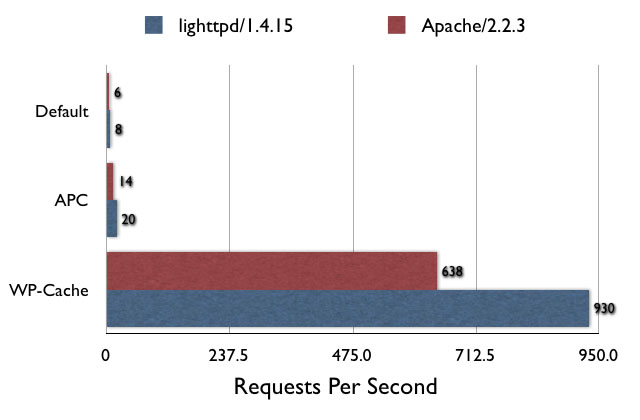
The showdown: apache vs. lighttpd - I’m Mike

The showdown: apache vs. lighttpd - I’m Mike: "The showdown: apache vs. lighttpd
Blogging, Web Development May 7th, 2007 - 5,026 views

Is lighttpd faster than Apache? Can Wordpress handle high traffic websites? Rumors spread like wildfire on the web, and sometimes it’s hard to separate the truth from evangelism and clever marketing. Today I’m going to put Wordpress to the test, running under Apache and lighttpd, and see if a clear winner emerges.

To find out more about how I came up with these numbers, check out my post explaining how to measure your web site’s performance.

For these tests I used ab, a popular benchmarking tool distributed as part of the Apache project. I ran each test multiple times, varying the number of concurrent connections. The results below show the maximum number of requests per second each server could handle with a default installation, with APC installed, and with WP-Cache enabled."lighttpd_vs_apache.jpg

lighttpd fly light

lighttpd fly light: "Security, speed, compliance, and flexibility -- all of these describe lighttpd (pron. lighty) which is rapidly redefining efficiency of a webserver; as it is designed and optimized for high performance environments. With a small memory footprint compared to other web-servers, effective management of the cpu-load, and advanced feature set (FastCGI, SCGI, Auth, Output-Compression, URL-Rewriting and many more) lighttpd is the perfect solution for every server that is suffering load problems. And best of all it's Open Source licensed under the revised BSD license.
Web 2.0

lighttpd powers several popular Web 2.0 sites like YouTube, wikipedia and meebo. Its high speed io-infrastructure allows them to scale several times better with the same hardware than with alternative web-servers.

This fast web server and its development team create a web-server with the needs of the future web in mind:

* Faster FastCGI
* COMET meets mod_mailbox
* Async IO

Its event-driven architecture is optimized for a large number of parallel connections (keep-alive) which is important for high performance AJAX applications."

DSL information

DSL information: "Damn Small Linux is a very versatile 50MB mini desktop oriented Linux distribution.

Damn Small is small enough and smart enough to do the following things:

* Boot from a business card CD as a live linux distribution (LiveCD)
* Boot from a USB pen drive
* Boot from within a host operating system (that's right, it can run *inside* Windows)
* Run very nicely from an IDE Compact Flash drive via a method we call 'frugal install'
* Transform into a Debian OS with a traditional hard drive install
* Run light enough to power a 486DX with 16MB of Ram
* Run fully in RAM with as little as 128MB (you will be amazed at how fast your computer can be!)
* Modularly grow -- DSL is highly extendable without the need to customize"

About - vLite - Windows Vista configuration tool

About - vLite - Windows Vista configuration tool: "vLite - Vista Lite

vLite is a tool for customizing the Windows Vista installation before actually installing it.

Main features are:

* hotfix, language pack and driver integration
* component removal
* unattended setup
* tweaks
* split/merge Vista installation CDs
* create ISO and burn bootable CD/DVD


Windows Vista from Microsoft takes a lot of resources, we all know that. vLite provides you with an easy removal of the unwanted components in order to make Vista run faster and to your liking.

This tool doesn't use any kind of hacking, all files and registry entries are protected as they would be if you install the unedited version only with the changes you select.

It configures the installation directly before the installation, meaning you'll have to remake the ISO and reinstall it. This method is much cleaner, not to mention easier and more logical than doing it after installation on every reinstall."

Slim Down Vista with vLite | ITsVISTA

Slim Down Vista with vLite | ITsVISTA: "Some of you may be familiar with a tool called ‘nLite’, which among other functions, helps remove unwanted components from Windows XP. There is now a similar tool available for Windows Vista called ‘vLite’. Here's a description from their website summarizing what vLite is about:"

Windows Vista from Microsoft takes a lot of resources, we all know that. So here is the tool for easy removal of unwanted components and bootable ISO creation in order to make Vista run faster and to your liking.

This tool doesn’t use any kind of hacking, all files and registry entries are in their original form and protected as they would be if you install the full version only without the components you select for the removal.

It configures the installation directly, before the installation, meaning you’ll have to remake the ISO and reinstall it. This method is much cleaner, not to mention easier and more logical than doing it after installation on every reinstall.

Mono brings Silverlight and Adobe AIR closer - News - Builder AU

Mono brings Silverlight and Adobe AIR closer - News - Builder AU: "Mono is an open source implementation of Microsoft's .Net framework. It lets developers use Microsoft tools and languages, like C#, to write applications that run on Windows, Linux, or Mac OS.

Part of the Mono project is Moonlight, an implementation of Silverlight that runs on Linux. Silverlight is a browser plug-in for rich Internet applications.

De Icaza said that some of the Moonlight work aims to let people write Silverlight applications that run standalone, outside the browser.

That's not something Microsoft offers right now. Many people expect the company to do that to compete with Adobe's AIR, which lets people use Web tools to write desktop applications.

The "Moonlight desklets" from Mono run standalone outside the browser, too. But de Icaza made it clear that there's quite a bit of work to make it easier to write them for all Mono-supported operating systems.

Ray Ozzie bringing 'syncromesh' to the Web | Outside the Lines - CNET News.com

Ray Ozzie bringing 'syncromesh' to the Web | Outside the Lines - CNET News.com: "Ray Ozzie has a history of trying to break through software and usability barriers. With Lotus Notes, he and his team spent years creating the underlying client/server collaboration technology to enable synchronization, or replication of e-mail online and offline."

Ray Ozzie is synchronizing Microsoft's software strategy.

(Credit: Dan Farber/CNET News.com)

His second major initiative, Groove Networks, took the synchronization and collaboration concept into the peer-to-peer realm, allowing individual PCs to communicate directly with one another.

Groove Networks was sold to Microsoft in March 2005, and Ozzie began his next major iteration on a much bigger stage, as Microsoft's chief software architect.

Ozzie teased the next evolution of his decades-long exploration of synchronization and collaboration, which he referred to as a "seamless mesh"--or what I'll call "syncromesh"--in his Mix '08 keynote in Las Vegas:
Just imagine the possibilities of unified application management across the device mesh, centralized, Web-based deployment of device-based applications. Imagine an app platform that's cognizant of all of your devices. Now, as it so happens, we've had a team at Microsoft working on this specific scenario for some time, starting with the PC and focused on the question of how we might make life so much easier for individuals if we just brought together all your PCs into a seamless mesh, for users, for developers, using the Web as a hub.

Microsoft to deliver first Live Mesh beta in late April | Mary Jo Foley | ZDNet.com

Microsoft to deliver first Live Mesh beta in late April | All about Microsoft | ZDNet.com: "Right now, the best way to understand where Microsoft is going with mesh is via what it’s doing with Windows Live FolderShare. FolderShare, which is based on technology Microsoft acquired when it bought FolderShare from ByteTaxi in 2005, is designed to allow users to keep their files in sync across their computers, share folders with associates and access files from any computer (or, ultimately, device).

Recently, Tom Kleinpeter, one of the founders of FolderShare — as well as one of the Live Mesh team members — left Microsoft. Kleinpeter didn’t respond to an e-mail I sent to him, asking him in search of more information on how FolderShare fits in with Microsoft’s mesh strategy.

After months of silence, Microsoft released an updated FolderShare beta in early March. A number of testers complained about compatibility problems following the beta release. Some testers also reported frustration over the failure of FolderShare to use Microsoft’s Windows Live ID authentication scheme, as well as the fact that FolderShare is not synchronized with Windows Live SkyDrive, Microsoft’s cloud-storage service, which also is in beta.

According to sources, Windows Live Mesh will be an amalgamation of FolderShare and SkyDrive and possibly unify those two services, which would provide users with a way to keep their local and cloud-based data in sync.

PC World - Business Center: Microsoft's Ozzie Talks Open Source, Mesh

PC World - Business Center: Microsoft's Ozzie Talks Open Source, Mesh: "The software industry 'used to be so supply constrained,' he said. 'You could build almost anything and there'd be an audience waiting for it.' Today, however, there's an abundance of software and services that users can choose from. That means Microsoft's challenge is to better understand what users want in order to best target their needs, he said."

Live Mesh To Push Microsoft's Synchronization Strategy - Microsoft Blog - InformationWeek

Live Mesh To Push Microsoft's Synchronization Strategy - Microsoft Blog - InformationWeek: "Other than its blue and white circular logo, the only thing we can be sure of about Live Mesh is that it's something that has significant support from top executives like Microsoft chief software architect Ray Ozzie, who fleshed out some tantalizing hints about Microsoft's synchronization strategy last month that were surrounded by more than a dozen mentions of a 'mesh' and synchronization.

Other than its blue and white circular logo, the only thing we can be sure of about Live Mesh is that it's something that has significant support from top executives like Microsoft chief software architect Ray Ozzie, who fleshed out some tantalizing hints about Microsoft's synchronization strategy last month that were surrounded by more than a dozen mentions of a "mesh" and synchronization.

However, it's not too hard to make some educated guesses about what Live Mesh is all about. Microsoft has a number of public synchronization projects in place, including FeedSync, the Sync Framework, SQL Server Data Services and ADO.NET Data Services (formerly Project Astoria), as well as Windows Live FolderShare and Windows Live SkyDrive. Plus, Ozzie's remarks, which previewed a "bi-directional synchronization of arbitrary feeds of all kinds," give us a clue as to how to put the puzzle together.

FeedSync (which was developed by Ray Ozzie himself) uses the XML-based Atom format to synchronize information such as feeds of photos. The Sync Framework is a full-on data synchronization platform for developers. SQL Server Data Services and ADO.Net (ActiveX Data Objects.Net) Data Services are online data stores and query processing services that can potentially be leveraged for synchronization. Live SkyDrive and Live FolderShare are essentially online storage services for consumers.

Each of these elements could be used by Microsoft to create a polished service that could allow users to choose what data they want to be synchronized with the help of the Internet and always have the most current version of content whenever they access it, regardless of device or location. These elements also could potentially be used by developers and consumers who wish to extend Live Mesh to meet their needs, though I'm not sure how that might look.

Rough Type: Nicholas Carr's Blog: Heavy metal cloud

Rough Type: Nicholas Carr's Blog: Heavy metal cloud: "I've looked at clouds from both sides now, and they're really freaking expensive. Google's capital expenditures, the lion's share of which go to building and outfitting data centers, soared to a record high of $842 million in the first quarter of this year, up from $678 million in the fourth quarter of '07, notes Data Center Knowledge. Should the company maintain its current pace of investment, its spending on data centers and related infrastructure will surpass $3 billion this year, a remarkable total."

Microsoft Unveils Wind-Powered Containers - Data Center Knowledge

Microsoft Unveils Wind-Powered Containers - Data Center Knowledge: "Microsoft is thinking a lot of about green power these days, as Michael Manos explained at Data Center World. Manos, Microsoft's director of data center services, believes the federal government will become more active on power issues. 'Sustainability regulation is coming,' he said. 'The conversation is not if, but when. It's more about what we're going to require companies to report against.'

With some data centers now provisioning more than 100 megawatts of power, utility capacity is a primary issue in data center site location. But it's likely that green power profiles are beginning to gain more weight as companies decide between specific cities and utilities. For now, the percentage of renewable energy vs. coal in a utility's generating base is probably serving as a tiebreaker between competing locations.

But that may change as more companies offer carbon neutrality pledges and federal agencies weigh sustainable IT as a regulatory issue. This is an area where container solutions have the potential to be disruptive, allowing companies to move computing infrastructure to places where they can run on wind, hydro or solar power. Will we see cities of container data centers springing up next to utility-scale thermal solar power plants in the Mojave Desert?"

Ning's Infinite Ambition -- Viral Networks -- Social Networking Start-Ups | Fast Company

Ning's Infinite Ambition -- Viral Networks -- Social Networking Start-Ups | Fast Company: "Here's something you probably don't know about the Internet: Simply by designing your product the right way, you can build a billion-dollar business from scratch. No advertising or marketing budget, no need for a sales force, and venture capitalists will kill for the chance to throw money at you.

It isn't just a site where users can build their own social networks -- Ning is a model of how to create a perpetual growth machine

The secret is what's called a 'viral expansion loop,' a concept little known outside of Silicon Valley (go ahead, Google it -- you won't find much). It's a type of engineering alchemy that, done right, almost guarantees a self-replicating, borglike growth: One user becomes two, then four, eight, to a million and beyond. It's not unlike taking a penny and doubling it daily for 30 days. By the end of a week, you'd have 64 cents; within two weeks, $81.92; by day 30, about $5.4 million.

Viral loops have emerged as perhaps the most significant business accelerant to hit Silicon Valley since the search engine. They power many of the icons of Web 2.0, including Google, PayPal, YouTube, eBay, Facebook, MySpace, Digg, LinkedIn, Twitter, and Flickr. But don't confuse a viral loop with viral advertising or videos such as Saturday Night Live's 'Lazy Sunday' or the Mentos-Diet Coke Bellagio fountain. Viral advertising can't be replicated; by definition, a viral loop must be."

Ning - Create your own Social Networks!

Ning - Create your own Social Networks!: "Ning is the only online service where you can create, customize, and share your own Social Network for free in seconds."

Let's Roll: one of Bush's better speeches

ISPs' Error Page Ads Let Hackers Hijack Entire Web, Researcher Discloses | Threat Level from Wired.com

ISPs' Error Page Ads Let Hackers Hijack Entire Web, Researcher Discloses | Threat Level from Wired.com:
By Ryan Singel April 19, 2008 | 2:00:00

Seeking to make money from mistyped website names, some of the United States' largest ISPs instead created a massive security hole that allowed hackers to use web addresses owned by eBay, PayPal, Google and Yahoo, and virtually any other large site.

The vulnerability was a dream scenario for phishers and cyber attackers looking for convincing platforms to distribute fake websites or malicious code."

Testing firefox 3 beta 5

hoping to fight those memory leaks even though its still only beta

Windows Server 2008 is better than Vista, but why? | Reg Developer

Windows Server 2008 is better than Vista, but why? | Reg Developer: "The short answer is that Server 2008 delivers new features that customers wanted, whereas Vista delivers new features that Microsoft thought its customers should want. However, it seems there may be more to it than that. Maybe Server 2008 really does perform better than Vista."

Saturday, April 19, 2008

Famous Presidential Speeches

Diana - A Case of You

Diana - Temptation

World

Cloud Tools for EC2

"WS Short Takes for Friday, April 18, 2008
from Amazon Web Services Blog by AWS Editor

I met developer Chris Richardson in Philadelphia last month. Chris is a seasoned Java developer and the author of POJOs in Action.

He told me that he had just released CloudTools. This is a set of tools for deploying and testing Java EE applications on Amazon EC2. It consists of AMIs that are configured to work with Apache Tomcat and to work with EC2Deploy, the EC2Deploy core framework (described here), and a Maven plugin which uses EC2Deploy. Once the plugin has been configured, one command will launch the appropriate number of EC2 instances, configure a master MySQL database, populate it with data, configure zero or more MySQL slaves, configure one or more Tomcat servers, deploy the actual web application, and then configure an Apache instance which will load balance across all of the Tomcat instances (whew!).

Welcome to Tahoe

Welcome to Tahoe
A "storage grid" is made up of a number of storage servers. A storage server has local attached storage (typically one or more hard disks). A "gateway" uses the storage servers and provides to its clients a filesystem over a standard protocol such as HTTP(S), FUSE, or SMB.

Users do not rely on storage servers to provide confidentiality nor integrity for the data -- instead all of the data is encrypted and integrity-checked by the gateway, so that the servers can neither read nor alter the contents of the files.

Users do rely on storage servers for availability. The ciphertext is erasure-coded and distributed across N storage servers (the default value for N is 10) so that it can be recovered from any K of these servers (the default value of K is 3). Therefore only the simultaneous failure of N-K+1 (with the defaults, 8) servers can make the data unavailable. Phrasing this in terms of reliance, we say that the users rely on the gateway for the confidentiality and integrity of the data, and on any 3 of the 10 servers for the availability of the data.

In the typical deployment mode each user runs her own gateway on her own machine. This way she relies on only her own machine for the confidentiality and integrity of the data, and she can take advantage of filesystem integration using FUSE or SMB.

An alternate deployment mode is that the gateway runs on a remote machine and the user connects to it over HTTPS. This means that the operator of the gateway can view and modify the user's data (the user relies on the gateway for confidentiality and integrity), but the user can access the filesystem with a client that doesn't have the gateway software installed, such as an Internet kiosk or cell phone.

Parallel Python Software

Parallel Python Software

Overview:

PP is a python module which provides mechanism for parallel execution of python code on SMP (systems with multiple processors or cores) and clusters (computers connected via network).

It is light, easy to install and integrate with other python software.

PP is an open source and cross-platform module written in pure python

Features:

  • Parallel execution of python code on SMP and clusters
  • Easy to understand and implement job-based parallelization technique (easy to convert serial application in parallel)
  • Automatic detection of the optimal configuration (by default the number of worker processes is set to the number of effective processors)
  • Dynamic processors allocation (number of worker processes can be changed at runtime)
  • Low overhead for subsequent jobs with the same function (transparent caching is implemented to decrease the overhead)
  • Dynamic load balancing (jobs are distributed between processors at runtime)
  • Fault-tolerance (if one of the nodes fails tasks are rescheduled on others)
  • Auto-discovery of computational resources
  • Dynamic allocation of computational resources (consequence of auto-discovery and fault-tolerance)
  • SHA based authentication for network connections
  • Cross-platform portability and interoperability (Windows, Linux, Unix, Mac OS X)
  • Cross-architecture portability and interoperability (x86, x86-64, etc.)
  • Open source

Apache CouchDB: The CouchDB Project

Apache CouchDB: The CouchDB Project: "The CouchDB Project

CouchDB Server Components


Apache CouchDB is a distributed, fault-tolerant and schema-free document-oriented database accessible via a RESTful HTTP/JSON API. Among other features, it provides robust, incremental replication with bi-directional conflict detection and resolution, and is queryable and indexable using a table-oriented view engine with JavaScript acting as the default view definition language."

Your own appengine

Your own appengine

My main gripe with appengine is that while you're sticking your app on a lot of iron, it's pretty much stuck there forever because of the infrastructure. Your app is not portable. You can't just take it off of Google's iron and host it yourself.

So, when I was listening to part 3 of the google app engine intro, I heard him describe BigTable as a "a distributed, fault-tolerant and schema-free", I knew I heard that before. I heard that from the CouchDB project. I never saw a need for CouchDB, but it's looking interesting now.

After looking at the SDK for appengine, the datastore interface is pretty simple, there's no reason it couldn't be implemented with CouchDB as the backend. Giving you your own "distributed, fault-tolerant and schema-free" datastore.

Also in part 3 that they run your python code on a low overhead, distributed, fault-tolerant infrastructure.. I knew I heard that before too. I heard it with the Parallel Python project.

Need a decentralized, fault-tolerant file system? There's Tahoe. Tahoo provides that too.

So let's say you have 20 servers, a mix match of database, media and http servers. Now instead of partitioning them to have their own roles, they become nodes in a cloud all handling http, appserving, media file serving and data storage.

If you create a webserver inside of parallel python that basically brokers requests for different sites to the parallel python cloud, a node in llpy then executes the request. llpy may contact the couchdb cloud. All using the power of the cloud. Therefore if you have 22 sites and only 5 get heavy traffic, you don't have to waste the power of the other 17 machines on the slow sites.

The appengine SDK looks like a start to create such a system. The datastore modules provide a way to interface CouchDB. Recreating the http brokering system with llpy shouldn't be that hard.

And once the django community finds a way to work it's ORM onto Google's datastore api (which I know they will), implementing Django inside your own parellel python/couchdb appengine wouldn't be hard.

Creating your own appengine wouldn't be for the average joe schmoe, It would be for big companies with some iron.

Worries about using GAE as a commercial platform?

18 April 2008 - Mark McLaren's Weblog: "Worries about using GAE as a commercial platform?

If I were a business with an interest in using GAE commercially, storing my valuable data in proprietary Google storage would worry me somewhat. There are open source versions of BigTable available (e.g. HBase, HyperTable) and these owe there existence to Google but as there is not yet a standard 'GQL' mechanism, data exit strategies seem limited.

I would be greatly concerned that my applications are hosted by Google and that my Python developers were exposed to Google. GAE could be described as a lobster pot. Getting Google to host your business means that Google are in a prime position to absorb successful businesses, steal talented developers, learn more about your business quicker than you can yourself and learn from your mistakes."

Django | The Web framework for perfectionists with deadlines

Django | The Web framework for perfectionists with deadlines: "Meet Django
Django is a high-level Python Web framework that encourages rapid development and clean, pragmatic design.

Developed and used over two years by a fast-moving online-news operation, Django was designed to handle two challenges: the intensive deadlines of a newsroom and the stringent requirements of the experienced Web developers who wrote it. It lets you build high-performing, elegant Web applications quickly.

Django focuses on automating as much as possible and adhering to the DRY principle.

Dive in by reading the overview →

When you're ready to code, read the installation guide and tutorial."

Twitter Tracking

This is what I'm currently tracking: "gae", "google app engine", "dojo", "yui", "bigtable", "mapreduce", "gdata", "gears", "google gadgets", "opensocial", "silverlight", "hadoop".

YouTube - Kelly Clarkson goes hardcore--Live

YouTube - Kelly Clarkson goes hardcore--Live

Python 3000

Guido van Rossum is a computer programmer who is best known as the author and Benevolent Dictator for Life of the Python programming language.

ABSTRACT
The next major version of Python, nicknamed Python 3000 (or more prosaically Python 3.0), has been anticipated for a long time. For years I have been collecting and exploring ideas that were too radical for Python 2.x, and it's time to stop dreaming and start coding. In this talk I will present the community process that will be used to complete the specification for Python 3000, as well as some of the major changes to the language and the remaining challenges.

Money for Nothing

Yahoo! 360� - Douglas Crockford's The Department of Style: "Money for Nothing

In the realm of music, it is pretty clear now, even to the so-called Music Industry, that DRM is not a viable business model. Apple's thralls still shop at iTunes, but The Rest of Us aren't buying it.

So the cartel is exploring a taxation model. They want a piece of all music sales and/or a piece of all music player sales, which would probably include all computers and cellphones, to compensate them for their failures to adapt to the changing technological landscape. The cartel is not entitled to your money and should not get it.

Your Congressional Representative is up for reelection this year, and maybe one of your Senators. So ask them where they stand on the Music Tax. Make it an issue. Remind them who they work for."

Friday, April 18, 2008

The GAE SWF Project at Aral Balkan

The GAE SWF Project at Aral Balkan: "Today I'm releasing The GAE SWF Project, a resource of Flash and Flex-related knowledge specifically aimed at getting you up and running quickly with Google App Engine. If you want to skip all the details and start playing with it, skip to the Getting Started section.

Everyone else, read on!

When Google announced Google App Engine last week, I couldn't believe what I was hearing. It was as if someone had said, 'Hey, Aral, tell us what your perfect development environment is and we'll build it for you.'"

Hadoop Summit Slides and Video Available

Hadoop Summit Slides and Video Available from Hadoop and Distributed Computing at Yahoo!
It's been a few weeks since the Hadoop Summit in Santa Clara, and we hope everyone had a good time and learned a lot. Feedback has been quite good so far, but don't be shy about sending us comments. The Yahoo! Research team has assembled a single page containing links to all the presentation slides and video from both the Hadoop Summit and the Data Intensive Computing Symposium. As a sample, here's the opening presentation that Doug and Eric gave: Update: Videos are currently unavailable outside of Yahoo! We're working on the problem..."

Interesting Info on First Quarter Conference Call

Listen to conference call

Google Datastore and the shift from a RDBMS

Google Datastore and the shift from a RDBMS: "Diving into the Datastore docs to get a grip on what’s the best way to implement it shed some light on the transition any developer thinking about writing data-backed apps for GAE (Google App Engine) will need to tackle.

Some notes on terminology, Google has Entities, Kinds, and Properties. These correspond roughly to Rows, Tables, and Columns in RDBMS-speak. Kinds can also be called classes, because in the Python API, you create a class and inherit from the appropriate datastore class. Entities may also be referred to as instances, since performing a query returns a list of objects (instances)."

Google AppEngine - A Second Look | High Scalability

Google AppEngine - A Second Look | High Scalability: "It's been a few days now since GAE (Google App Engine) was released and we had our First Look. It's high time for a retrospective. Too soon? Hey, this is Internet time baby. So how is GAE doing? I did get an invite so hopefully I'll have a more experience grounded take a little later. I don't know Python and being the more methodical type it may take me a while. To perform our retrospective we'll take a look at the three sources of information available to us: actual applications in the AppGallery, blogspew, and developer issues in the forum."

RescueTime

Frequently Asked Questions | RescueTime: "RescueTime is a web-based time-management tool that allows you to easily understand how you spend your time. One of the coolest things about RescueTime is that there is NO DATA ENTRY. You install a doohicky on your computer and we magically track all of your time usage. For more info, check out the product tour.

Cool idea, but I always have a lot of different applications and sites open at any given time. How does RescueTime handle that ?
RescueTime doesn't really care which applications you have open, but rather pays attention to which applicaiton or site is currently 'in focus'. In other words, we're measuring what's what you are paying attention to, not what you have open."

Thursday, April 17, 2008

twitter.zappos.com

I must confess that I've never really "got" Twitter, so today I went on a campaign to follow as many participants as I can to try and get a sense of the zeitgeist. The article belong is the best into I've seen and the first thing I noticed was that it seemed more useful via a mobile phone that a web browser. I've started using Google Talk as my main interface. When you type help into it you get a menu:

Reply with what you're doing.
'invite' to invite a friend.
'follow' to receive updates.
'track' to track interests.
'whois' for info.
'off' to silence.

Typing the commands gives more help. You can follow me by typing: follow CardHolder. You can silence me with: off CardHolder and unfollow me with: leave CardHolder.

Perhaps the most interesting feature was one i wasn't previously aware of, you can track keywords that you are interested in as they come up in peoples tweets. To track "yui" for instance you type: track yui. The opposite operation is: untrack yui.

I've set up a series of tracks on topics of interest to this blog, we'll see how it goes.

---MG

twitter.zappos.com: "I know that I've been spending about half an hour every time I try to convince my friends to sign up for Twitter. At first, they think it sounds interesting but aren't really motivated to sign up. Sometimes it's been a multi-week long process. But finally they relent and sign up, probably just so they can shut me up. I walk them through the signup process, step by step, and then slowly but surely, they become addicted and their lives are never the same again.

So to save me from having to give the same spiel over and over again, I decided to create this page for anyone new to Twitter."

Todd Bishop's Microsoft Blog

Todd Bishop's Microsoft Blog: "Ballmer says Vista is a 'work in progress'

More than a year after Windows Vista's release, Microsoft CEO Steve Ballmer this morning acknowledged some of the operating system's shortcomings -- calling it a 'work in progress' during a speech to the company's Most Valuable Professionals conference in Seattle. He also acknowledged Windows XP's fans, but he stopped short of committing to further extend the older operating system's life.

Here's an extended excerpt from his comments on the topic:

Windows Vista: A work in progress. [Laughter, applause.] A very important piece of work, and I think we did a lot of things right, and I think we have a lot of things we need to learn from. Certainly, you never want to let five years go between releases. Can we just sort of kiss that stone and move on? Because it turns out many things become problematic when you have those long release cycles. The design point, what you should be targeting. We can't ever let that happen again. We had some things that we can't just set the dial back, but I think people wish we could. Vista is bigger than XP. It's going to stay bigger than XP. We have to make sure it doesn't get bigger still, and that the performance and that the battery life and that the compatibility, we're driving on the things that we need to drive hard to improve."

Twubble

Twubble: "Looking for more people to follow?

Twubble can help expand your Twitter bubble—it searches your friend graph and picks out people who you may like to follow. Click the button below to get started."

How to Add Google Analytics to Your Blogger Blog

How to Add Google Analytics to Your Blogger Blog: "How to Add Google Analytics to Your Blogger Blog

Yesterday we talked about Google Analytics, Google’s free service that lets you track the performance of your websites and blogs from one simple, easy-to-use interface.
Grab Your Google Analytics Code Block

1. Login to Google Analytics at http://google.com/analytics/. The main Settings page loads.
2. Click on Add Website Profile. A form displays.
3. Select Add a Profile for a New Domain.
4. Enter the URL of your site or blog.
5. Select your country and time zone. Click Finish.
6. Analytics provides you with a code block - a swatch of HTML - to add to your site’s pages.
7. Highlight the code block and then copy it by selecting Edit > Copy or Ctrl-C or Command-C."

Add the Google Analytics Code Block to Your Blogger Blog

  1. Login to http://www.blogger.com/. The Dashboard loads.
  2. Under the blog you want to add Analytics tracking to, click on Layout or Template.
  3. Click on Edit HTML. An editing screen for your blog template’s HTML displays. Don’t freak out. Just scroll to the bottom.
  4. Look for the end of the template. It’ll look like:


(Google Analytics Code Block is going to go here!!!)

  1. Put your cursor right before that tag.
  2. Paste the Google Analytics Code Block by selecting Edit > Paste, Ctrl -V or Command-V.
  3. Click Save Changes.

You have now added the Google Analytics Code Block to Your Blogger Blog.

Check Your Work

  1. To ensure that you have successfully added the Google Analytics Code Block to your Blogger blog, go back to http://google.com/analytics/.
  2. Next to your blog’s URL it will say either Receiving Data (you were successful) or Tracking Not Installed (something is amiss).
  3. If it said Tracking Not Installed, click on Check Status. Google then checks your blog for the Analytics Code Block and reports back if it find it or not.
  4. If not, try re-pasting the Code Block in.